
Dismantling the Doctrine of Discovery
Digging out the roots of an invasive theological weed


I spend a lot of time thinking about 15th-century Catholic conversations, not because I love history but because I am interested in current events. As a theologian and Christian ethicist who works in the area of racial injustice, I am amazed at how the frameworks established more than 500 years ago continue to shape contemporary attitudes and assumptions, but in a very hidden way.
This week we will look at the call to dismantle the Doctrine of Discovery after further illuminating what it is and how it functions. Next week we will turn to a new iteration of the Doctrine of Discovery that is raising its head with new force and vigour.
A colleague of mine, a pastor of a church here in Canada, seeking to build bridges to a better relationship with Indigenous neighbours in his community, went to a meeting of Chief and Council to propose a joint learning event between his church and that community. The Chief asked him, about 5 minutes into his presentation, “Have you read the Doctrine of Discovery?” To which his response was, “No, I haven’t even heard of it.” “Once you have read it, come back and then we can talk,” cam
e the response. What was hidden to my colleague was a prominent form of oppression to his neighbours.
When the missionaries came to Africa they had the Bible and we had the land. They said 'Let us pray.' We closed our eyes. When we opened them we had the Bible and they had the land.
This quote by Desmond Tutu has resonance for Indigenous Peoples in Canada as well and the case law justification for that wholesale theft of land was and is the Doctrine of Discovery which created the framework for the legal fiction of Crown Land.
In 2015, the United Nations Standing Committee on Indigenous Peoples decided to refer to the policies and papal bulls that resulted in the Doctrine of Discovery as “the Doctrine of Christian Domination. " These practices have moved far beyond the original mandates of the Catholic Church and continue to shape culture to this day.
Calls to Repudiate the Doctrine of Discovery
In the summer of 2022, Pope Francis visited Canada in response to a call to action from the final report of the Truth and Reconciliation Commission (TRC), which was issued in 2015. Call to Action #58 called for the Pope to come to Canada and formally repudiate the Doctrine of Discovery and the doctrine of terra nullius (empty land). The repudiation of these doctrines received some attention in the media, but many non-Indigenous Canadians wondered why these old statements made by the Catholic Church were relevant today.
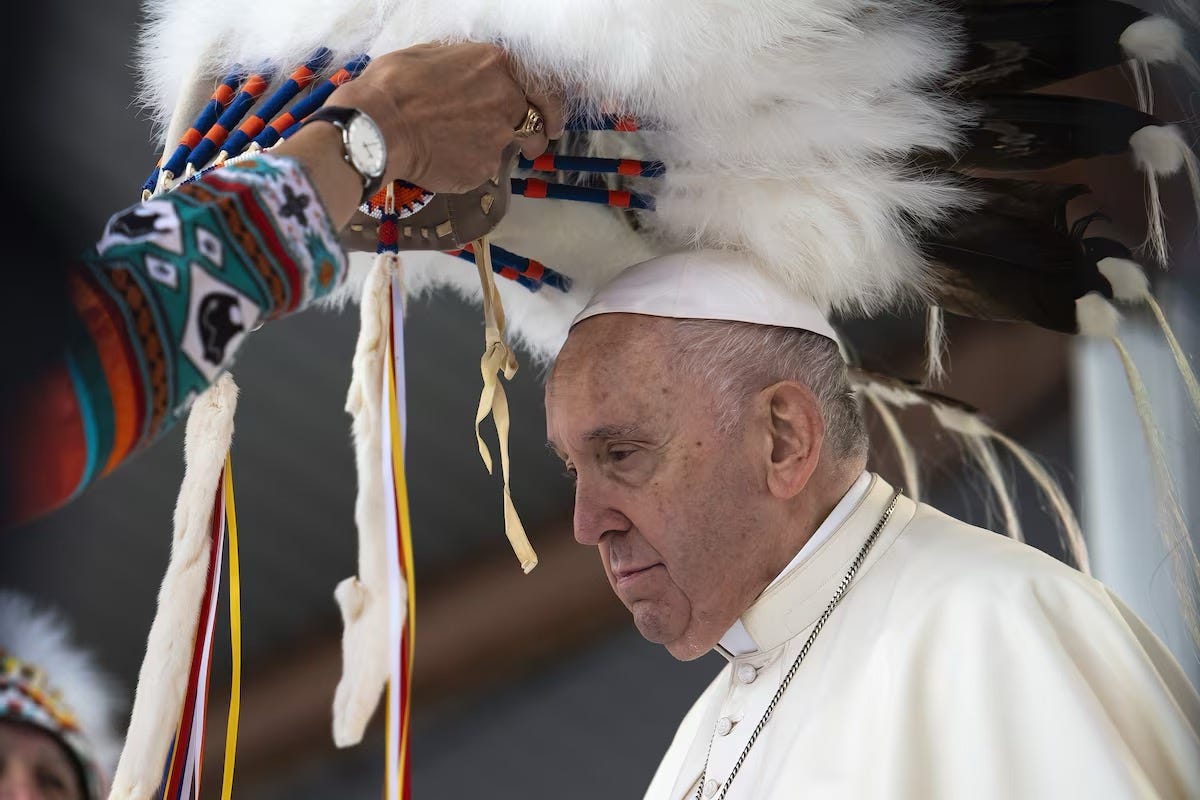
Moreover, while there are certainly strong Catholic influences in Canada, some felt that the monarchs of England had a much more substantial impact on the formation of Canada than any Catholic papal bulls. Thus, Call to Action #47 from the final report of the TRC also appealed to the Canadian government to repudiate the Doctrine of Discovery and “to reform those laws, government policies and litigation strategies that continue to rely on such concepts.”[1]
Those Canadians who actually read the text of the various papal decrees from the Age of European Exploration are often appalled and cannot understand why it took so long for the Pope and the Canadian government to repudiate them.[2] But now that both the Pope and the Canadian government have repudiated these harmful doctrines, many Canadians are eager to move on because they feel the damage was done so long ago.
Yet a simple statement repudiating these doctrines cannot untangle the legal fiction created by them, for these principles undergird the entire framework upon which Canada has been built. Moreover, they continue to call the shots in the background—just as they have for a long time. Both the church and the state need to do far more to uncover the vestiges of these damaging doctrines so that healthy relationships can be restored among all peoples who live in Canada.
Dismantling the Doctrine of “Crown Land” in the Canadian Legal System
Within the Canadian legal system, particularly in regard to Indigenous land claims, the onus is put on Indigenous Peoples to prove their (often uninterrupted) connection to the land.[3] Yet the Crown’s claim to these lands is based on the doctrine of terra nullius (empty land), an idea that was established long after the first Europeans were received as guests onto the land. Obviously, Europeans knew that the land wasn’t empty (thus they needed rules about how to make converts), but they justified the doctrine of “empty land” by arguing that only Christians had the right to posses land.
In the paper “Sovereignty’s Alchemy: An Analysis of Delgamuukw v. British Columbia,” John Borrows, a lawyer from the Chippewa of the Nawash First Nation in Ontario, argues that the Crown’s claim to the land is less valid than the original Aboriginal title. According to the Crown, Aboriginal title was established when European sovereignty was imposed. Yet Borrows argues that this is an inadequate justification for the diminishment of Aboriginal occupation and possession, and so he suggests subjecting the Crown’s sovereignty to the same standards of evidence that it requires for proof of Aboriginal self-government.[4]
Dismantling Practical Apartheid: the Ongoing Impact of the Indian Act
The Indian Act has also been a persistent force throughout Canada’s history, dominating the lives of Indigenous Peoples, yet largely invisible to non-Indigenous Canadians.[5] In fact, for more than a hundred and fifty years, the Indian Act has been creating a system of practical apartheid in Canada by establishing one system for how Indigenous Peoples should be governed and another system for how non-Indigenous people should be governed.[6]
For example, education for non-Indigenous children is managed by the Department of Education in each province or territory. But on reserve, education is managed by the federal government. To give another example, if you live on a reserve and your house is full of mold or your roof needs to be repaired, you are not allowed to make those repairs without the authorization of the federal government because Indigenous People are not allowed to own homes on reserve. Substandard housing is considered to be a matter of the owner’s neglect, not the resident, and for reserve housing, the owner of housing is the federal government.
Moreover, living conditions on reserve are radically disparate from those off reserve, and students on reserve perform academically at a much lower level than non-reserve students. Yet Canadians do not place the responsibility for improving living conditions or education on reserve upon the federal government, but on the reserve communities themselves—without recognizing the immense barriers to making such changes and improvements. This two-tiered system treats Indigenous Peoples as “wards of the state,” children without a parent. And through this system, the racism and Euro-centric attitudes of the Doctrine of Discovery continue to play out today.
Next week we will turn to the new phenomenon of Christian Dominionism and its very old roots in the Doctrine of Discovery.
[1] Sinclair, Littlechild, Wilson, Canada’s Residential Schools, 5.
[2] One theological problem for the Catholic church is the law of infallibility, which pertains to the teachings of the Pope. Because of this belief, one Pope cannot declare the statements of a previous Pope to have been wrong without undermining this law of infallibility.
[3] The argument for this is laid out in Manuel and Derrickson, Reconciliation Manifesto, ch. 8.
[4] Borrows, “Sovereignty’s Alchemy.” Borrows article has been widely cited since it was published in the Osgood Law Journal in 1999. Courts in turn have leaned in this direction since that time for reasons more complex than Borrow’s article alone, but it certainly has made a significant impact.
[5] The Indian Act was implemented in 1876 and governs the lives of status First Nations People. It does not apply to those without status, nor to Metis or Inuit Peoples. The Act has been amended various times, most significantly in 1951, 1985, 2011, and 2017.
[6] Standing Committee on Aboriginal Affairs and Northern Development, Evidence by Mr. Rob Clark, March 19, 2013, https://www.ourcommons.ca/documentviewer/en/41-1/aano/meeting-64/evidence.